



SparkFun DataLogger IoT - 9DoF
CHF 77.15


Frequently Bought Together
16 items


Content: 100 Stück (CHF 0.02 / 1 Stück)


Content: 5 Meter (CHF 7.51 / 1 Meter)


Description
Product information "SparkFun DataLogger IoT - 9DoF"
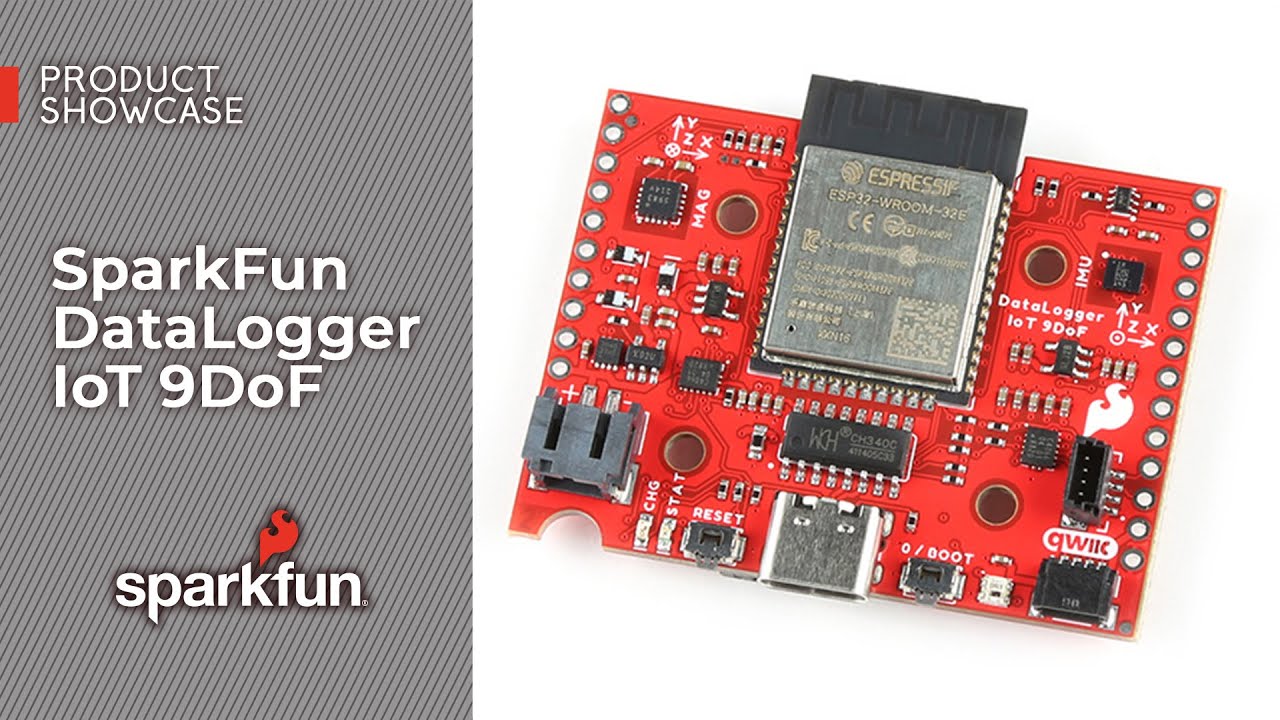
Each DataLogger IoT is equipped with an IMU that records a three-axis accelerometer, a gyroscope and a magnetometer. While the original 9DOF Razor used the old MPU-9250, the DataLogger IoT uses the ISM330DHCX from STMicroelectronics and the MMC5983MA from MEMSIC. Simply switch on the DataLogger IoT, configure the board to record readings from supported devices and start logging! The data can be time-stamped if the time is synchronised with NTP, GNSS or RTC.
The DataLogger IoT is configurable via an easy-to-use serial interface. Simply plug in a USB-C cable and open a serial terminal at 115200 baud. The logging output is automatically streamed to both the terminal and the microSD card. Pressing any button in the terminal window will open the configuration menu.
The DataLogger IoT - 9DoF automatically scans, detects, configures and logs various Qwiic sensors connected to the board (no soldering, no programming!). Currently, automatic detection is supported by the following Qwiic products:
- All u-Blox GNSS modules (latitude/longitude, altitude, speed, SIV, time, date) such as
- ZED-F9P 1cm High Precision GPS
- NEO-M8P-2 2.5cm High Precision GPS
- SAM-M10Q 1.5m GPS
- SAM-M8Q 1.5m 72 channel GPS
- ZOE-M8Q 1.5m Compact GPS
- NEO-M9N 1.5 m GPS
- MAX-M10S 1.5 m Ultra-Low Power GPS
- Inertial measurement unit (accelerometer and gyro):
- ISM330DHCX IMU (Built-in via SPI)
- Magnetometer:
- MMC5983 (Built-in via SPI)
- Distance
- TMF8820 dToF Imager
- TMF8821 dToF Imager
- VCNL4040 Proximity and Lux
- VL53L1X Distance - 4 metres
- VL53L4 Distance - 1.3 metres
- VL53L5 ToF Imager
- Pressure, altitude, humidity and temperature data
- BME280 Atmospheric
- LPS25HB Absolute pressure
- MPR Series - MPRLS0025PA00001A Micro pressure
- MS8607 Pressure, humidity and temperature
- MS5637 Barometric pressure and temperature
- AHT20 Humidity and temperature
- SHTC3 Humidity and temperature
- SDP31 Differential pressure
- BMP384 Pressure and temperature
- BMP581 Pressure and temperature
- Air quality and environmental sensors
- CCS811 Air quality (CO2 and VOC)
- SGP30 Air quality (TVOC, CO2, H2, ethanol)
- SGP40 Air quality (VOC, humidity, temperature)
- SCD30 CO2, humidity and temperature
- SCD40 CO2, humidity and temperature
- BME680 Air quality (pressure, humidity, temperature, gas, VOCs)
- BME688 Air quality (pressure, humidity, temperature, gas, VOCs, VSC, CO, gas)
- FS3000 Air velocity
- SEN54 Environmental sensor node (particles, VOCs, humidity and temperature)
- STC31 CO2 and temperature sensor
- VEML6075 UV
- VEML7700 Ambient light and lux
- Temperature
- AMG8833 Grid-EYE infrared array
- MCP9600 Thermocouple amplifier
- PT100 ADS122C04 PR Temperature
- TMP117 High-precision temperature
- Power
- ACS37800 Power meter
- MAX17048 Li-Po battery fuel gauge (built-in)
- Real-time clock
- RV8803 RTC module
- NFC/RFID
- ST25DVxxKC Dynamic NFC/RFID tag
- Biometric sensors
- Biomedical Sensor Hub (MAX32664) with pulse oximeter and heart rate (MAX30101)
- Weight
- NAU7802 Qwiic Scale Load Cell Amplifier
- Other
- Qwiic push button
- Qwiic Twist RGB Rotary Encoder
- Analogue voltage
- ADS1015 12-bit 4-channel differential ADC
- ADS122C04 24-bit differential ADC on the PT100
Low-power logging is supported. The DataLogger IoT can be configured to take readings approximately 26 times per second with the sensors switched on by default, or as slow as 1 reading every 24 hours. The choice is yours! The DataLogger IoT has a built-in LiPo charging station with a capacity of 500 mA/hour. When sleep mode is activated, the resulting quiescent current is around 200µA.
With a 2.4GHz WiFi connection, you can also send data to the cloud! The following IoT services are supported:
- MQTT Client
- MQTT Secure Client
- AWS IoT
- ThingSpeak MQTT
- Azure IoT
- HTTP IoT
- MachineChat
Features:
- ESP32-WROOM-32E module
- Integrated 802.11b/g/n WiFi 2.4GHz transceiver
- Configurable via CH340C
- Operating voltage range
- 3.3V to 6.0V (via VIN)
- 5V with USB (via 5V or USB type C)
- 3.6V to 4.2V with LiPo battery (via BATT or 2-pin JST)
- Built-in MCP73831 single cell LiPo charger
- Minimum 500mA charging current
- 3.3V (via 3V3)
- MAX17048 LiPo fuel gauge
- Connections
- 1x USB type C
- 1x JST connector for LiPo battery
- 2x Qwiic capable I2C
- 1x microSD socket
- Support for 4-bit SDIO and microSD cards formatted with FAT32
- 9-axis IMU
- Accelerometer & gyroscope (ISM330DHCX)
- Magnetometer (MMC5983MA)
- LEDs
- Charge (CHG)
- Status (STAT)
- WS2812-2020 Addressable RGB
- Jumpers
- IMU interrupt
- Magnetometer interrupt
- RGB LED
- Status LED
- Charging LED
- I2C pull-up resistors
- USB shield
- Buttons
- Reset
- Boot
- Dimensions: 1.66in. x 2.00in.
- Weight: 10.7g
Properties
| Zolltarifnummer: | 85176200 |
|---|---|
| Brand: | SparkFun |
| Country of Origin: | USA |
| EAN: | 4060137085192 |
| Gross Weight (kg): | 0.011 |
| Manufacturer ID: | DEV-20594 |
| Product ID: | DEV-20594 |
Manufacturer
SparkFun
SparkFun – open-source electronics from Colorado
SparkFun Electronics was founded in Boulder, Colorado in 2003 and is one of the defining companies of the maker movement. The idea behind it: electronics should be accessible to everyone. That is why SparkFun publishes the schematics and layouts of its products as open-source hardware and accompanies them with detailed guides and tutorials.
Development and manufacturing take place in the USA. SparkFun is best known for the Qwiic system, which allows sensors and modules to be combined via plug connection without soldering, as well as for the Thing Plus and MicroMod platforms for IoT and embedded projects.
At BerryBase you will find a large selection of genuine SparkFun products – from breakout boards for quick prototypes to development boards for professional applications.
Manufacturer and safety information
SparkFun Electronics
6333 Dry Creek Parkway
DE CO 80503 Niwot
https://www.sparkfun.com
support@sparkfun.com
WEEE number: 17968585
Responsible person for the EU
Sertronics GmbH
Am Studio 20d
DE 12489 Berlin
https://www.berrybase.de
info@berrybase.de
Safety instructions
- Do not bring into direct contact with water or moisture, as the electronics may be damaged.
- Protect against static discharge, e.g. by earthing the work surface.
- Keep away from extreme temperatures and direct sunlight.
- Only install or remove connections and modules using suitable tools.
- Do not use force to insert the module into a connection or socket.
- Before installation, ensure that the power supply is switched off.
- Only operate with the voltage specifications specified by the manufacturer.
- Do not use defective or damaged devices and dispose of them properly.
- Do not dispose of electronic components in household waste; dispose of them in accordance with local regulations for electronic waste.
- Keep components out of the reach of children.
- Check the data logger regularly for software updates to avoid security gaps.
- Store in a dry, cool environment for longer periods.
Reviews 0
Login
Customers also viewed


