



SparkFun ESP8266 Thing, Dev Board, with headers
CHF 24.10


Description
Product information "SparkFun ESP8266 Thing, Dev Board, with headers"
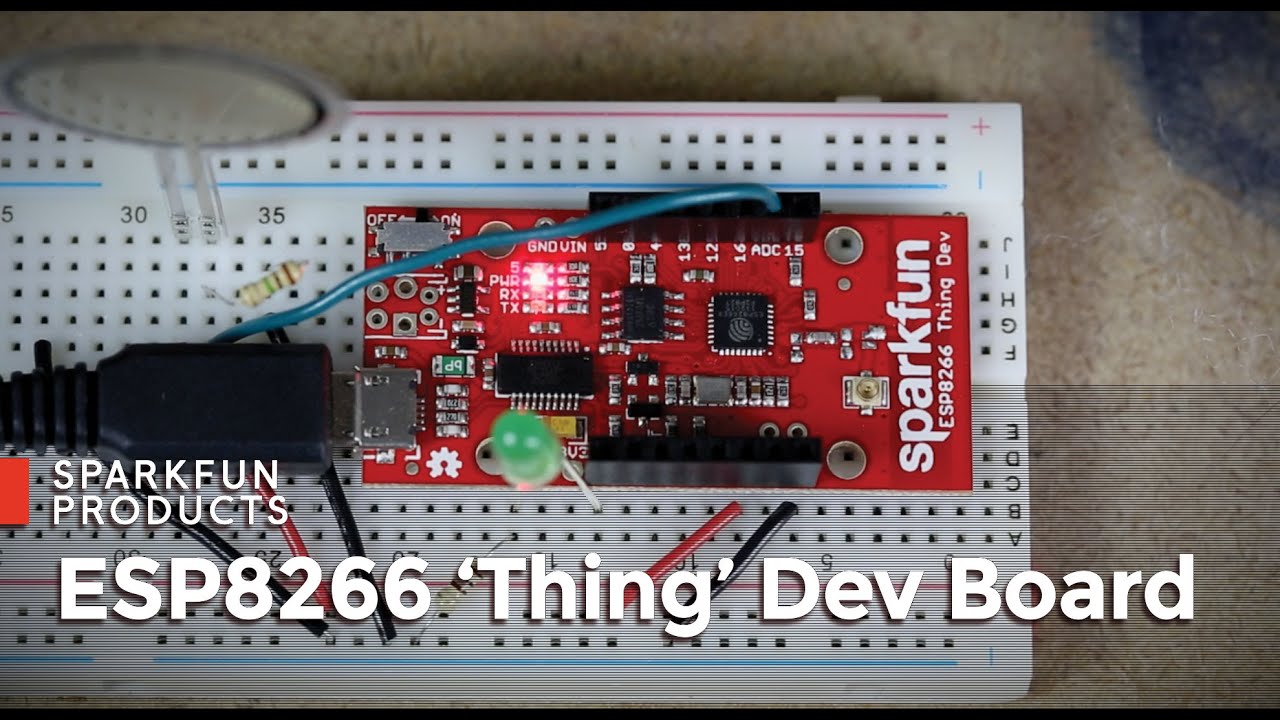
Why the name? We affectionately call it the "Thing" because it's the perfect foundation for your Internet of Things (IoT) project. The Thing does everything from switching on an LED to sending data and can be programmed like any microcontroller. You can even program the Thing via the Arduino IDE by installing the ESP8266 Arduino add-on.
The ESP8266 Thing Development Board is a relatively simple board. The pins are divided into two parallel, breadboard-compatible rows. The USB connector sits next to an optional power supply input, and an ON/OFF switch --- to control the power supply to the ESP8266 --- sits next to it. LEDs on the inside of the board indicate the power supply, the charge level and the status of the IC. The maximum voltage of the ESP8266 is 3.6V, so the Thing has a 3.3V regulator on board to provide a safe, constant voltage to the IC. This means that the I/O pins of the ESP8266 also run at 3.3V; you will need to balance any 5V signals going into the IC. If your project requires a power source other than USB, the Thing Dev Board includes footprints for a 2-pin JST, 2-pin 3.5mm screw connector or a simple 0.1" pitch 2-pin header. Unlike the original ESP8266 Thing, the ESP8266 Thing Dev Board does not have a built-in LiPo charger.
The Thing Dev Board even includes a trace antenna as a standard WiFi antenna. It's inexpensive and works really well! If you want to connect a more sensitive antenna or route it outside of an enclosure, there is also a U.FL connector on the board. There is some soldering required to get the U.FL connector working, but instructions can be found in the hookup guide we wrote for the dev board.
Note: We have provided some example sketches for you to experiment with on your SparkFun ESP8266 Thing Development Board. These sketches can be found in the Hookup Guide in the Documents section below!
Features:
- All module pins broken out
- Onboard FTDI USB-to-serial
- 802.11 b/g/n
- WiFi Direct (P2P), Soft-AP
- Integrated TCP/IP protocol stack
- Integrated TR switch, balun, LNA, power amplifier and matching network
- Integrated PLLs, regulators, DCXO and power management units
- Integrated low-power 32-bit CPU can be used as application processor
- +19.5dBm output power in 802.11b mode
- Pre-soldered pin headers
Properties
| Zolltarifnummer: | 85423911 |
|---|---|
| Brand: | SparkFun |
| Country of Origin: | USA |
| EAN: | 5904422312572 |
| Gross Weight (kg): | 0.007 |
| Manufacturer ID: | WRL-13804 |
| Product ID: | WRL-13804 |
Manufacturer
SparkFun
SparkFun – open-source electronics from Colorado
SparkFun Electronics was founded in Boulder, Colorado in 2003 and is one of the defining companies of the maker movement. The idea behind it: electronics should be accessible to everyone. That is why SparkFun publishes the schematics and layouts of its products as open-source hardware and accompanies them with detailed guides and tutorials.
Development and manufacturing take place in the USA. SparkFun is best known for the Qwiic system, which allows sensors and modules to be combined via plug connection without soldering, as well as for the Thing Plus and MicroMod platforms for IoT and embedded projects.
At BerryBase you will find a large selection of genuine SparkFun products – from breakout boards for quick prototypes to development boards for professional applications.
Manufacturer and safety information
SparkFun Electronics
6333 Dry Creek Parkway
DE CO 80503 Niwot
https://www.sparkfun.com
support@sparkfun.com
WEEE number: 17968585
Responsible person for the EU
Sertronics GmbH
Am Studio 20d
DE 12489 Berlin
https://www.berrybase.de
info@berrybase.de
Safety instructions
- Use the Dev. Board only in accordance with the instructions and technical specifications.
- Keep the board away from liquids, moisture and extreme heat.
- Avoid static discharges and use appropriate ESD protection measures if necessary.
- Never work on the electrical wiring while the board is connected to a power source.
- Only allow children to work with the device under supervision as it contains small parts.
- Dispose of the product in an environmentally friendly manner at a recognised recycling centre for electronic devices.
- Observe local regulations for the disposal of electronics and batteries.
Reviews 0
Login
